
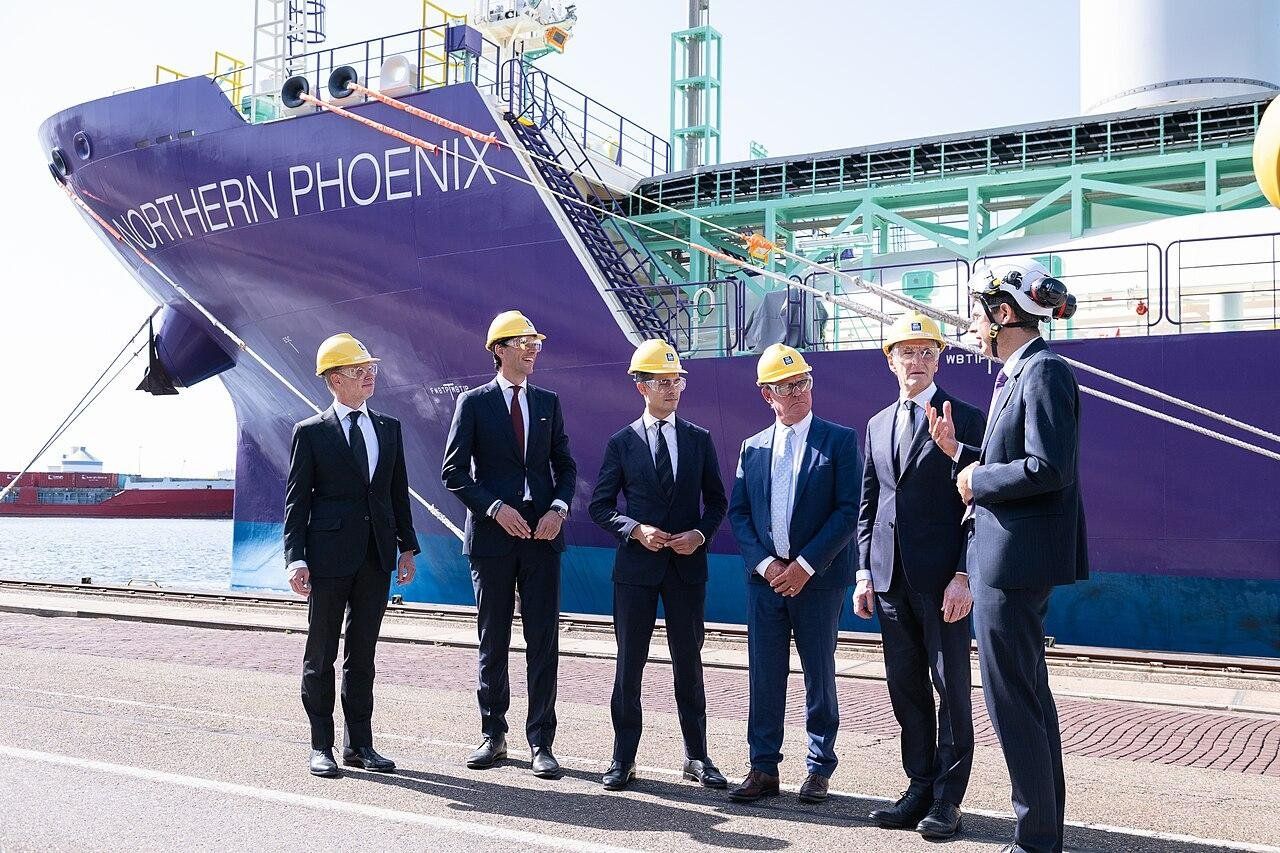

On 7 September 2026, Yara opened a carbon capture facility at its ammonia plant in Sluiskil, Zeeland. The captured CO2 is shipped to Norway and stored under the North Sea by Northern Lights. Norwegian Prime Minister Jonas Gahr Støre, Dutch Prime Minister Rob Jetten and EU Climate Commissioner Wopke Hoekstra attended the opening.
For the Norwegian-Dutch business community, it is the clearest example so far of the two countries' industries working as one value chain: emissions captured in the Netherlands, stored in Norway.
How the chain works
- Capture: up to 800,000 tonnes of CO2 a year from ammonia production at Sluiskil, Europe's largest ammonia and fertiliser plant. This is process CO2, which is already highly concentrated and therefore the cheapest CO2 to capture.
- Shipping: the CO2 is liquefied and held in tanks on site, then collected by Northern Lights' purpose-built carriers of 7,200 tonnes each.
- Storage: the ships deliver to the Northern Lights terminal at Øygarden on Norway's west coast. From there a pipeline of around 100 km carries the CO2 to a reservoir about 2,600 metres below the seabed.
Over 15 years, Yara expects to store around 12 million tonnes. Northern Lights is a joint venture of Equinor, Shell and TotalEnergies and part of Norway's Longship programme. It started injecting CO2 in 2025 with cargoes from Heidelberg Materials' cement plant in Brevik. Yara is its first customer from outside Norway. The two companies agreed the main terms in August 2022 and signed the binding contract in November 2023.
The business case
The investment is reported at around €200 million, with €30 million from the Dutch government. Every tonne stored is a tonne for which Yara does not have to surrender EU ETS allowances, and CEO Svein Tore Holsether has been open that this is the main driver for now: "This is about avoiding costs now." He added that scaling the model across Europe also needs demand for low-carbon products, such as low-carbon fertiliser, ammonia and shipping fuel.
What it does not solve
The 800,000 tonnes is roughly a quarter of the plant's total emissions of just over 3 million tonnes a year. Most of the rest comes from burning fuel for process heat, where the CO2 is more diluted and costly to capture, and from CO2 that is already used to make urea or sold to other users. Deeper cuts will need different production routes. Storage is also tight in the short term: the first phase of Northern Lights, 1.5 million tonnes a year, is fully booked, and the second phase of at least 5 million tonnes a year is due in 2028.
Why it matters for our members
- For Dutch industrial emitters, Sluiskil shows that shipping CO2 to storage in Norway works at scale. The next step is securing capacity in Northern Lights' second phase, part of which is still unsold.
- For Norwegian suppliers in shipping, offshore services and engineering, cross-border CCS is becoming a market with Dutch customers.
- Two of our members are directly involved: Yara is a NORDCC Patron member, and Equinor, a co-owner of Northern Lights, is a Corporate member.
Sources
- Yara: Europe's largest carbon capture facility officially inaugurated at Yara Sluiskil, 7 September 2026
- Yara: Carbon capture and storage in action, the Sluiskil project
- Northern Lights: binding agreement with Yara on CO2 transport and storage, 20 November 2023
- gCaptain: Europe's largest carbon capture facility opens, sending CO2 by ship to North Sea storage, 8 September 2026
- Industrylinqs: Holsether on avoiding ETS costs through CO2 capture in Sluiskil, 10 September 2026
- Industry Decarbonization: Yara's CCS project shows limitations of blue hydrogen and ammonia, 16 September 2026